Language Anxiety at Work: How Teams Can Help Employees Speak Up
Last updated on
Employees who work in an additional language may have valuable ideas but need more time to formulate them, especially in fast meetings or high-status discussions. Silence should not automatically be interpreted as agreement, lack of expertise, or lack of preparation. Managers can reduce the language burden without lowering professional expectations by making participation more predictable and giving people more than one way to contribute.
For a practical next step, continue with Talkio’s professional communication practice guide. For an independent description of real-world communication skills, consult the Council of Europe’s CEFR Companion Volume.
Design meetings for multilingual participation
- Share the agenda and decision questions early enough for everyone to prepare.
- Use clear turn-taking and pause before moving on from an open question.
- Allow written input before or after the meeting for complex points.
- Offer role-specific speaking practice while treating accent diversity as normal.
Understanding Language Anxiety in the Workplace
Think of language anxiety as a quiet shadow, it follows even the most talented professionals into meetings, presentations, and client calls. At its core, it’s the fear of speaking up because of the possibility of mistakes, misunderstandings, or sounding “off.”
The cost of this fear isn’t small. Ideas stay hidden, collaboration slows, and career growth stalls when voices go unheard. A team may think the silence means agreement, when in reality, it’s hesitation wrapped in self-doubt.
And it’s not just about grammar. For many, the real hurdle is pronunciation, using the right tone, or navigating cultural nuances across multiple dialects. Even employees fluent in their second language can hesitate if they worry about “how” they’ll sound more than “what” they’ll say. Recognizing this silent barrier is the first step to breaking it.
Signs Your Team May Be Holding Back
Sometimes, the hints are right in front of you. You notice someone skipping their turn to give a verbal update, sticking to chat messages instead of speaking up, or keeping their responses short and cautious. These aren’t signs of disinterest, they can be signs of language anxiety at work.
One manager shared how a major product improvement almost never happened. A team member had the idea for weeks but waited until a private one-on-one to mention it, fearing they’d stumble over words in the bigger meeting. That hesitation delayed a solution everyone needed.
Spotting these patterns isn’t about pointing fingers, it’s about opening doors. Once you see them, you can create safer spaces for people to contribute, knowing that the difference between “no input” and “unspoken input” can change the course of a project.
Why the Usual Training Doesn’t Always Work
Here’s the thing. Most corporate language programs aren’t built for the real, messy conversations that happen at work. They’re often too formal, sticking to scripted dialogues and textbook grammar that don’t match the pace or tone of everyday meetings.
Then there’s the lack of real-time speaking practice. Reading aloud from a slide or repeating phrases from a video isn’t the same as thinking on your feet during a client call. Without that experience, confidence stays shaky.
And finally, feedback matters. Without clear, personalized input on pronunciation and phrasing, employees are left guessing where they went wrong. This is where life-like voice conversations and pronunciation practice tools shine, they let learners rehearse, make mistakes privately, and correct them instantly, without an audience. That kind of safe space turns hesitation into habit.
Turning Silence into Confidence
Confidence isn’t built in a single meeting; it’s shaped in the moments leading up to it. When employees have a safe space to rehearse, the fear of “getting it wrong” starts to fade.
Here’s a simple framework you can follow:
Practice in Real Contexts
Simulate actual work scenarios, team updates, client calls, or brainstorming sessions, so practice feels relevant, not abstract.
Get Feedback Without Pressure
Use tools that offer detailed feedback on pronunciation and phrasing so mistakes become learning moments, not public slip-ups.
Start Small, Then Expand
Encourage low-stakes speaking opportunities before high-pressure presentations, confidence grows step by step.
Platforms like Talkio allow employees to engage in life-like voice conversations, receive instant corrections, and refine their skills at their own pace.
Takeaway
Language anxiety may quiet a voice for a moment, but it doesn’t have to keep it silent forever. When employees feel safe to speak, they don’t just contribute more, they grow, connect, and lead with confidence.
A thriving workplace isn’t built on perfect sentences; it’s built on shared ideas, honest input, and the courage to speak up.
Fluency is more than grammar, it’s the ability to be understood, valued, and heard. The more you nurture that, the more your team’s potential will turn into progress everyone can see and feel.
Talk Your Way
to Fluency
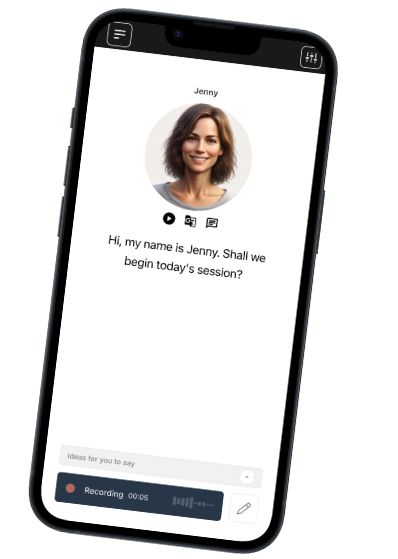
Talkio is the ultimate language training app that uses AI technology to help you improve your oral language skills!
Try Talkio